Physical Address
304 North Cardinal St.
Dorchester Center, MA 02124
Physical Address
304 North Cardinal St.
Dorchester Center, MA 02124

By Europe Update Staff
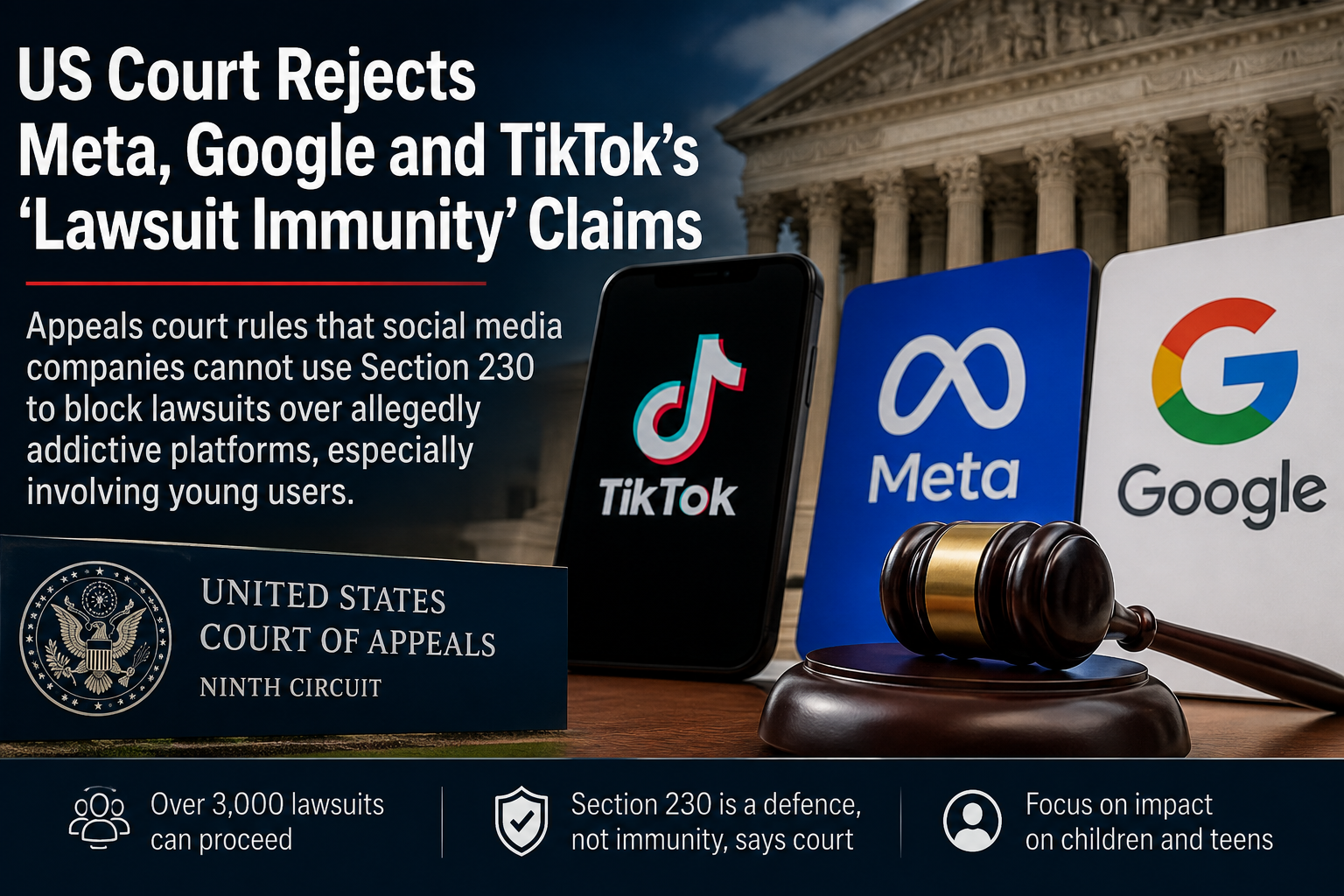
A US federal appeals court has allowed thousands of lawsuits against major social media companies to continue, rejecting an attempt by technology giants to stop the cases at an early stage.
The lawsuits target companies including Meta, Google and TikTok, with plaintiffs accusing them of developing platform features that encourage excessive and potentially addictive use.
The cases are particularly focused on the impact of social media on children and teenagers.
The ruling from the US Court of Appeals for the Ninth Circuit does not determine whether the companies are ultimately responsible for the alleged harm. Instead, the court ruled that the companies had attempted to challenge the lower-court decision before the cases had reached a stage where such an appeal was appropriate.
More than 3,000 lawsuits are involved in the wider legal dispute.
The cases have been brought by individuals, families, school districts, municipalities and government authorities across the United States.
Plaintiffs claim that social media companies intentionally designed their services to maximise user engagement and encourage people, particularly younger users, to spend more time on their platforms.
They argue that certain features can contribute to problems including anxiety, depression, body-image concerns and other difficulties affecting young people’s wellbeing.
The companies have disputed the allegations and continue to defend their platforms.
A central issue in the dispute is Section 230 of the Communications Decency Act, a US law introduced in 1996.
Section 230 generally protects online platforms from being held legally responsible for content created and posted by their users.
The technology companies argued that the law should provide protection against lawsuits claiming that their platforms were designed in ways that could encourage addictive behaviour.
They sought to challenge a lower-court ruling that allowed the lawsuits to proceed, arguing that Section 230 gave them a broader form of legal protection.
The appeals court disagreed with that interpretation.
The Ninth Circuit determined that the companies’ appeal was premature.
US appeals generally take place after a lower court has issued a final decision or judgment. In this case, the underlying litigation is still continuing.
The court therefore declined to consider the companies’ challenge at this stage.
The decision also distinguished between having a legal defence against liability and having complete immunity from being sued.
That distinction could become important as the lawsuits move forward.
Readers can find official opinions, court information and judicial resources through the US Court of Appeals for the Ninth Circuit.
The lawsuits reflect a growing debate about the way modern social media platforms are built.
Features such as infinite scrolling, autoplay, personalised recommendations, notifications and engagement rewards are designed to make platforms easy and attractive to use.
Critics argue that these features can encourage people to remain online for extended periods.
The plaintiffs claim that companies should be held accountable if platform design contributes to harmful patterns of use, particularly among children and teenagers.
The companies, however, maintain that their platforms provide valuable communication and entertainment services and continue to contest the allegations made against them.
Youth safety is another important part of the broader legal debate.
Some lawsuits allege that certain platform features can make it easier for adults to contact underage users.
Snapchat, for example, has faced allegations concerning features that recommend potential friends or connections to users.
Such cases have increased pressure on technology companies to strengthen protections for minors and reconsider how their platforms operate when children are involved.
Read Also: Wildfires Spread Across Spain as Hundreds Evacuated in Huelva and Castellón
Meta, which owns Facebook and Instagram, is already facing separate legal challenges related to the alleged effects of its platforms on young users.
Authorities in New Mexico have taken action against the company, with proceedings involving claims concerning child safety and the potential impact of Meta’s services.
These cases add to growing legal and political pressure on the company in the United States.
The latest ruling should not be interpreted as a final victory for the plaintiffs.
The Ninth Circuit did not conclude that Meta, Google, TikTok or other technology companies are responsible for addiction, mental-health problems or other alleged harms.
Instead, the court’s decision means that the lawsuits can continue through the normal legal process.
The plaintiffs will still need to establish their claims, while the technology companies will have opportunities to defend themselves and challenge the allegations.
The wider litigation could eventually become an important test of how Section 230 applies to today’s technology platforms.
When the law was introduced in 1996, social media as it exists today had not yet developed.
Modern platforms rely heavily on algorithms that recommend content, personalise feeds and encourage users to interact with services repeatedly.
That difference has fuelled debate over whether legal protections created during the early internet era remain suitable for today’s technology industry.
The eventual outcome of the lawsuits could have consequences beyond the companies currently involved.
If courts determine that certain platform designs can expose companies to legal liability, technology businesses could face pressure to change features that are designed to maximise engagement.
That could affect everything from recommendation algorithms to notifications, scrolling systems and tools aimed specifically at younger users.
On the other hand, a decision favouring the technology companies could strengthen their ability to defend similar lawsuits using existing federal protections.
The lawsuits will continue in lower courts, where evidence and legal arguments surrounding platform design, user behaviour and alleged harm can be examined in greater detail.
The technology companies are expected to continue defending themselves and may raise additional legal challenges as individual cases progress.
The litigation could take considerable time before reaching final judgments.
The dispute is part of a broader global discussion about the responsibilities of social media companies.
Governments, regulators, parents and schools are increasingly questioning how digital platforms affect young users and whether companies should face stronger obligations to protect children.
The US cases could therefore become closely watched beyond the courtroom.
Their eventual outcomes may influence future regulation, product design and the legal relationship between technology companies and their users.
The Ninth Circuit’s decision represents an important development in the growing legal battle between major technology companies and groups accusing them of creating potentially addictive social media platforms.
For now, Meta, Google, TikTok and other companies will have to continue defending themselves in court rather than relying on an immediate Section 230 appeal to stop the cases.
The ruling does not establish liability, but it allows thousands of lawsuits to move forward.
As the cases develop, courts will face a much broader question: how should decades-old internet protections apply to powerful platforms whose modern algorithms are designed to keep users engaged?





[…] Read Also: US Appeals Court Allows Social Media Addiction Lawsuits Against Big Tech to Continue […]