Physical Address
304 North Cardinal St.
Dorchester Center, MA 02124

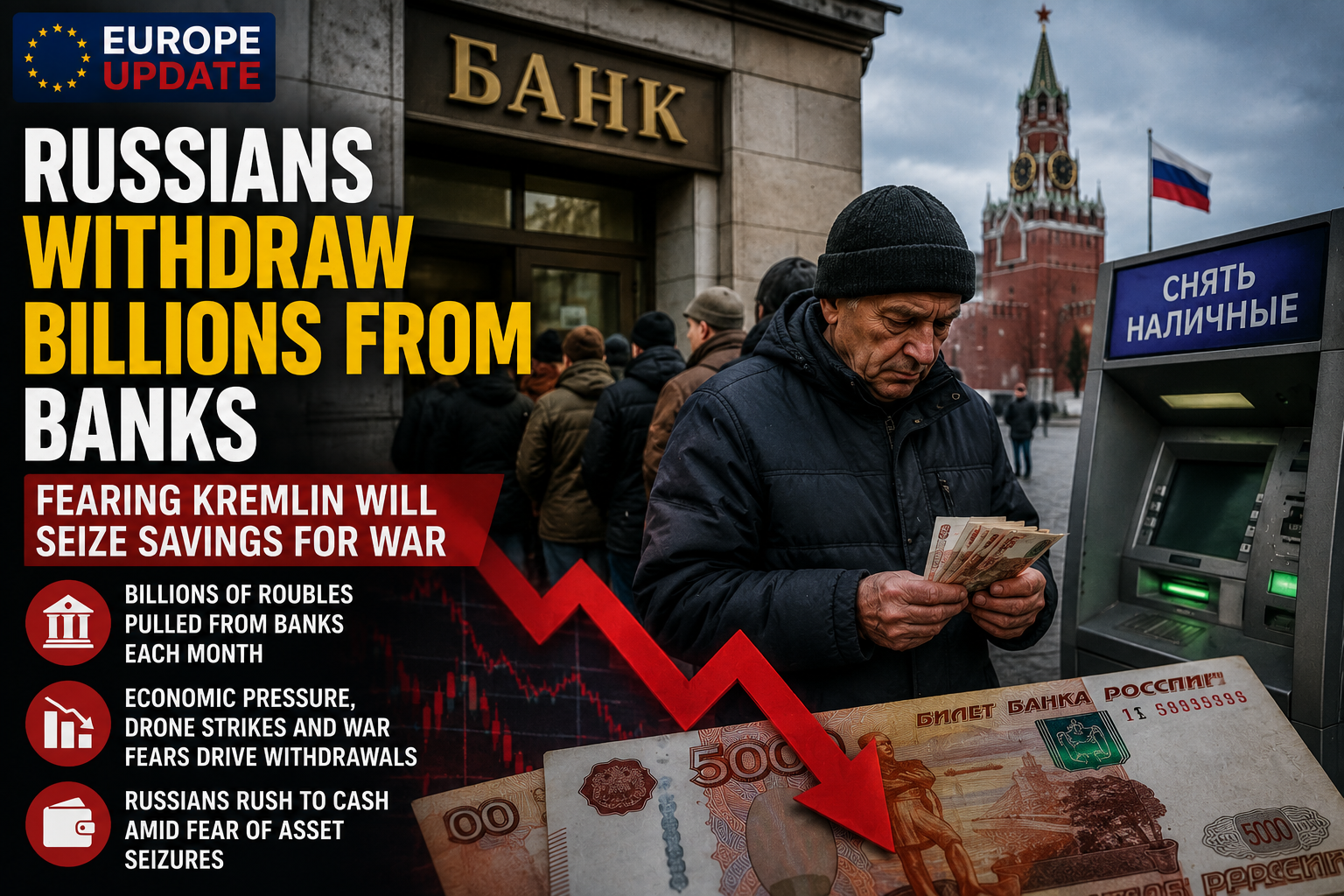
Rising cash withdrawals are putting a spotlight on financial confidence in Russia, as households react to economic pressure, the continuing war in Ukraine and concerns about possible government intervention in private assets.
Russia is experiencing a notable increase in demand for cash, with billions of roubles being withdrawn from banks in recent months. The movement comes as Ukrainian attacks continue to target Russian energy and logistics infrastructure and the country’s economy faces growing pressure.
Recent reporting based on Russian central-bank data indicates that withdrawals accelerated through June, July and the first part of August. Nearly 286.4 billion roubles was withdrawn during the first two weeks of August alone, according to figures cited by The Washington Post.


The increase in withdrawals is becoming an important indicator of consumer confidence.
People do not necessarily withdraw money because they expect a banking collapse. During periods of uncertainty, households often prefer to hold cash because it gives them immediate access to their savings and reduces their dependence on financial institutions.
The latest figures suggest that this behaviour has become more widespread in Russia.
Five of the country’s largest banks have reportedly experienced net outflows of individual deposits. Gazprombank, Rosselkhozbank, Alfa-Bank, Sovcombank and VTB have all recorded declines, while T-Bank has been an exception.
The movement is also reflected in broader monetary data published by the country’s central bank.
For readers wanting to monitor Russia’s official financial indicators, the Bank of Russia official website provides regularly updated information on the country’s banking system, money supply and financial markets.
There is no single explanation for the withdrawals.
One factor is the continuing uncertainty surrounding Russia’s economy. Military spending remains high, while sanctions, labour shortages and disruptions to the energy sector are creating additional challenges.
Another factor is the continuing war in Ukraine.
Ukrainian forces have increasingly used long-range drones to target Russian oil refineries, fuel facilities and logistics infrastructure. Damage to these facilities has contributed to fuel shortages in parts of Russia and added pressure to an economy already operating under wartime conditions.
For some households, withdrawing money may therefore be a precaution rather than a sign that they expect an immediate financial collapse.
A more sensitive issue is the fear that the Russian government could eventually impose restrictions on private savings.
There is no evidence that Russia has announced a nationwide plan to confiscate ordinary citizens’ bank deposits. However, previous state takeovers of private and foreign-owned assets have contributed to concerns about property rights.
Those concerns have gained renewed attention after Russian authorities transferred major private assets into state control.
In June, Russian authorities confiscated assets worth about 550 billion roubles, or roughly $7.6 billion at the time, linked to billionaire Vadim Moshkovich. The move was described as one of the largest nationalisations in Russia’s recent history.
Read the latest reporting on Russia’s asset seizures
Such cases involve wealthy individuals and companies rather than ordinary bank customers. Nevertheless, they can influence public perceptions about the security of private wealth.
The increase in withdrawals should not automatically be interpreted as a banking crisis.
Russian banks continue to operate, and the Bank of Russia retains significant tools for managing liquidity and supporting financial stability.
The current situation is better understood as a warning about confidence.
If people move some of their savings into cash, banks can normally manage the change. The situation becomes more serious if withdrawals accelerate rapidly and remain elevated for a prolonged period.
A sustained deposit outflow could force banks to rely more heavily on other sources of funding and could make financial conditions tighter.
The cash withdrawals are occurring against a difficult economic backdrop.
Russia’s economy contracted by 0.2% year-on-year in the first quarter of 2026, according to Rosstat’s preliminary estimate. The result marked a sharp change from the growth recorded previously.
The Russian government has also lowered its expectations for economic growth this year.
Russia’s latest economic and GDP reporting reported in July that Russia’s Economic Development Ministry had reduced its 2026 GDP growth forecast to 0.4%, down from an earlier estimate of 1.3%.
The slowdown matters because the Kremlin continues to spend heavily on defence and the war effort.
Russia’s energy infrastructure has become an increasingly important target in the conflict.
Ukrainian drone attacks have hit oil refineries and other energy facilities deep inside Russia. These attacks can temporarily reduce refining capacity, disrupt fuel distribution and increase logistical costs.
Russia has already acknowledged petrol shortages in some regions.
The economic effect goes beyond the energy sector. Higher fuel costs can affect transportation, agriculture, manufacturing and consumer prices.
For Russian households, repeated shortages and economic uncertainty may reinforce the desire to keep part of their savings in immediately accessible cash.
Many Russians remember the financial uncertainty that followed Russia’s full-scale invasion of Ukraine in 2022.
At that time, households rushed to withdraw cash and buy foreign currencies as Western sanctions triggered major market volatility.
The Bank of Russia responded with emergency measures, including a major increase in interest rates and temporary capital controls.
The financial system eventually stabilised.
That experience, however, may still influence how Russian consumers react when they see signs of renewed economic pressure.
The movement of money is not limited to households.
Large Russian companies have also been managing their finances carefully as sanctions restrict access to international markets and the domestic economy becomes increasingly focused on wartime production.
Capital outflows can be particularly significant because they reduce the amount of money available for domestic investment.
At the same time, banks must balance government-directed lending, corporate financing and household savings while maintaining adequate liquidity.
For individual depositors, the current situation presents a difficult choice.
Keeping money in a bank can provide interest income and access to financial services, while holding physical cash provides immediate access but carries its own risks.
A sudden move by millions of people to withdraw their savings could put additional pressure on banks.
However, the available evidence does not show that Russia is currently facing a nationwide bank run.
Instead, the data point to an increase in precautionary cash holdings at a time when confidence in the country’s economic outlook is being tested.
The bigger issue may therefore be public confidence rather than the immediate health of individual banks.
Russia’s financial system has survived major shocks since 2022. But maintaining confidence becomes harder when people face weaker economic growth, fuel shortages, sanctions and continuing military uncertainty.
The government’s handling of private assets is another factor that could influence perceptions of financial security.
For now, concerns about widespread seizure of ordinary citizens’ deposits remain fears rather than an announced government policy.
That distinction is important.
The coming months will show whether the recent withdrawals represent a temporary reaction or the beginning of a longer-lasting shift away from bank deposits.
If cash withdrawals decline, the episode could prove to be another short-term response to uncertainty.
If they continue at elevated levels, however, economists and policymakers may view the trend as evidence of weakening confidence among Russian households.
The situation will also depend on the wider war, energy infrastructure attacks, government spending and Russia’s economic performance.
For now, Russia’s banking sector remains operational. But the growing movement of money from bank accounts into cash provides another sign that economic uncertainty is increasingly affecting ordinary Russians.
The country’s financial authorities will therefore have to watch deposit flows closely while attempting to maintain confidence in the banking system and the wider economy.





[…] Read Also: Russians Withdraw Billions From Banks Amid War Fears […]