Physical Address
304 North Cardinal St.
Dorchester Center, MA 02124

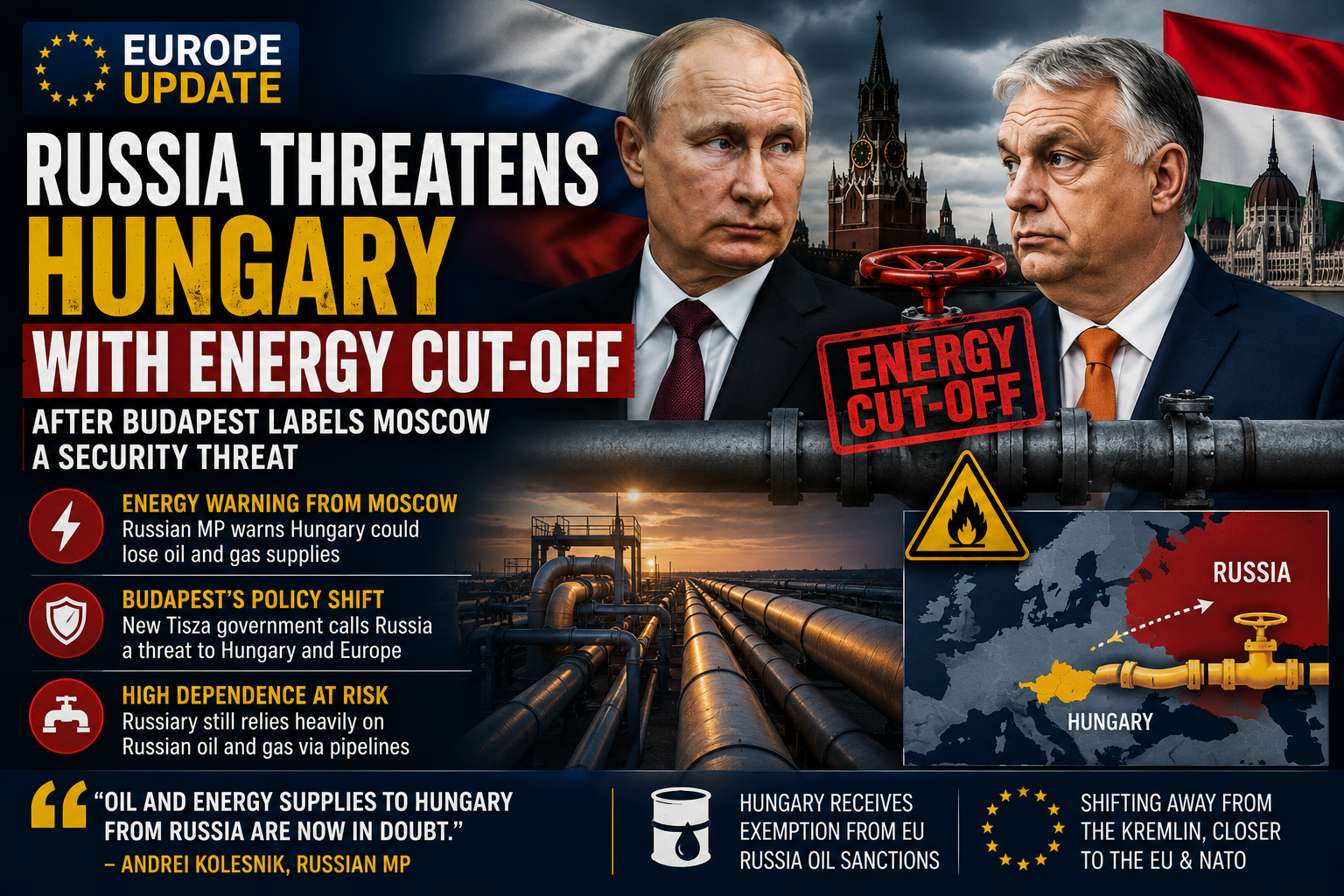
Hungary’s relationship with Russia has entered a new and uncertain phase after Budapest adopted a tougher position toward Moscow, prompting a Russian lawmaker to warn that the country’s access to Russian oil and natural gas could be put at risk.
The warning comes after Hungary’s new government signalled a major shift in foreign policy, describing Russia as a security threat and moving away from the close relationship that existed between Budapest and the Kremlin during the Viktor Orbán era.
Hungary’s new foreign policy direction marks one of the biggest changes in the country’s approach to Russia in recent years. According to the government’s position, Budapest now strongly condemns Russia’s military actions against Ukraine and supports Ukraine’s sovereignty and territorial integrity.
The new approach also calls for efforts to achieve a lasting peace and establish stronger security guarantees in Europe.
By describing Russia as a threat to Hungary, Europe and the wider international order, the government has placed itself much closer to the position taken by many of its EU and NATO partners.
The change is particularly significant because Hungary was previously seen as one of Moscow’s closest partners inside the European Union.
The diplomatic shift quickly drew criticism from Moscow. Andrei Kolesnik, a member of Russia’s State Duma Defence Committee, suggested that Hungary’s access to Russian energy could now be in question.
His comments raised concerns because Hungary remains heavily dependent on Russian oil and gas compared with many other EU countries.
According to a European Commission assessment, Hungary relied on Russia for more than 70% of its natural gas and over 80% of its crude oil consumption in 2024, highlighting how difficult a sudden disruption could be for the country.
The broader EU strategy has been focused on reducing this dependency. The European Commission’s REPowerEU energy strategy aims to gradually end Russian energy imports while encouraging member states to diversify their supplies.
For years, Hungary’s energy relationship with Russia has been a major part of its foreign policy. The country has continued receiving Russian energy through long-established pipeline networks, even as the European Union introduced sanctions and reduced imports following the war in Ukraine.
Hungary and other landlocked countries faced particular challenges in replacing pipeline supplies because of infrastructure and geographic limitations.
The EU has nevertheless continued moving towards a long-term phase-out of Russian fossil fuels. Under the latest European plans, Russian gas imports are scheduled to be progressively removed from the EU market, while remaining Russian oil imports are also expected to be addressed through diversification measures.
For more information about the EU’s wider plans, readers can explore the European Commission’s roadmap for ending dependence on Russian energy.
The political significance of the new policy goes far beyond energy.
Under former Prime Minister Viktor Orbán, Hungary frequently pursued a more cautious approach toward Moscow than many other European governments. Budapest repeatedly questioned or delayed some EU measures targeting Russia and maintained strong political and economic ties with the Kremlin.
The new government appears determined to change that direction.
Its decision to identify Russia as a security concern sends a clear message that Hungary intends to strengthen cooperation with its European and NATO allies while reassessing its relationship with Moscow.
However, the shift also creates risks. Energy remains one of the most sensitive areas of Hungary’s economy, and any major disruption to Russian supplies could place pressure on households, businesses and government finances.
The warning from the Russian lawmaker does not necessarily mean that Moscow has made an official decision to halt energy exports to Hungary.
Russia had not formally announced an energy blockade in response to Hungary’s policy change. However, the comments underline how energy can become a powerful tool during periods of political tension.
Europe has already experienced the risks associated with energy dependence during the wider conflict between Russia and Ukraine. The European Commission has argued that reducing reliance on Russian energy is essential for improving long-term energy security across the continent.
Readers can also see the European Commission’s plan to phase out Russian gas and oil imports for details about the EU’s diversification strategy.
Budapest now faces the challenge of pursuing a stronger security policy while managing its continued dependence on Russian energy.
Moving away from Moscow politically may be easier than replacing the country’s oil and gas supplies overnight. Building new infrastructure, securing alternative suppliers and protecting consumers from higher energy prices could take years.
The situation also reflects a broader challenge facing Europe: political independence and energy independence are closely connected.
The EU has already made significant progress in cutting Russian energy imports, with the share of Russian gas in the bloc’s overall imports falling sharply since the start of the war. However, some member states remain more exposed than others.
For a wider overview, visit REPowerEU’s four-year progress report.
The latest dispute could become an important test of Hungary’s new foreign policy.
If relations between Budapest and Moscow continue to deteriorate, energy cooperation may become an increasingly sensitive issue. At the same time, Hungary will face growing pressure to accelerate its search for alternative oil and gas supplies.
For now, there has been no official confirmation that Russia plans to cut energy deliveries. But the warning has highlighted Hungary’s continuing vulnerability and demonstrated how quickly energy issues can become part of a wider geopolitical confrontation.
Hungary’s move away from the Kremlin represents a major political shift. Whether the country can successfully reduce its dependence on Russian energy may determine how far that transformation can ultimately go.