Physical Address
304 North Cardinal St.
Dorchester Center, MA 02124
Physical Address
304 North Cardinal St.
Dorchester Center, MA 02124

By Europe Update Staff
Europe is facing an increasingly serious water shortage as prolonged heat, drought and rising demand place pressure on rivers, lakes and underground reserves.
Although extreme summer temperatures have made the situation more visible, Europe’s water problem is not simply the result of this year’s heat. Years of intensive consumption, ageing infrastructure, pollution and declining natural water supplies have contributed to a wider crisis affecting communities and ecosystems across the European Union.
Water restrictions remain in force in several parts of the bloc, while authorities are looking for ways to protect supplies during increasingly difficult weather conditions.
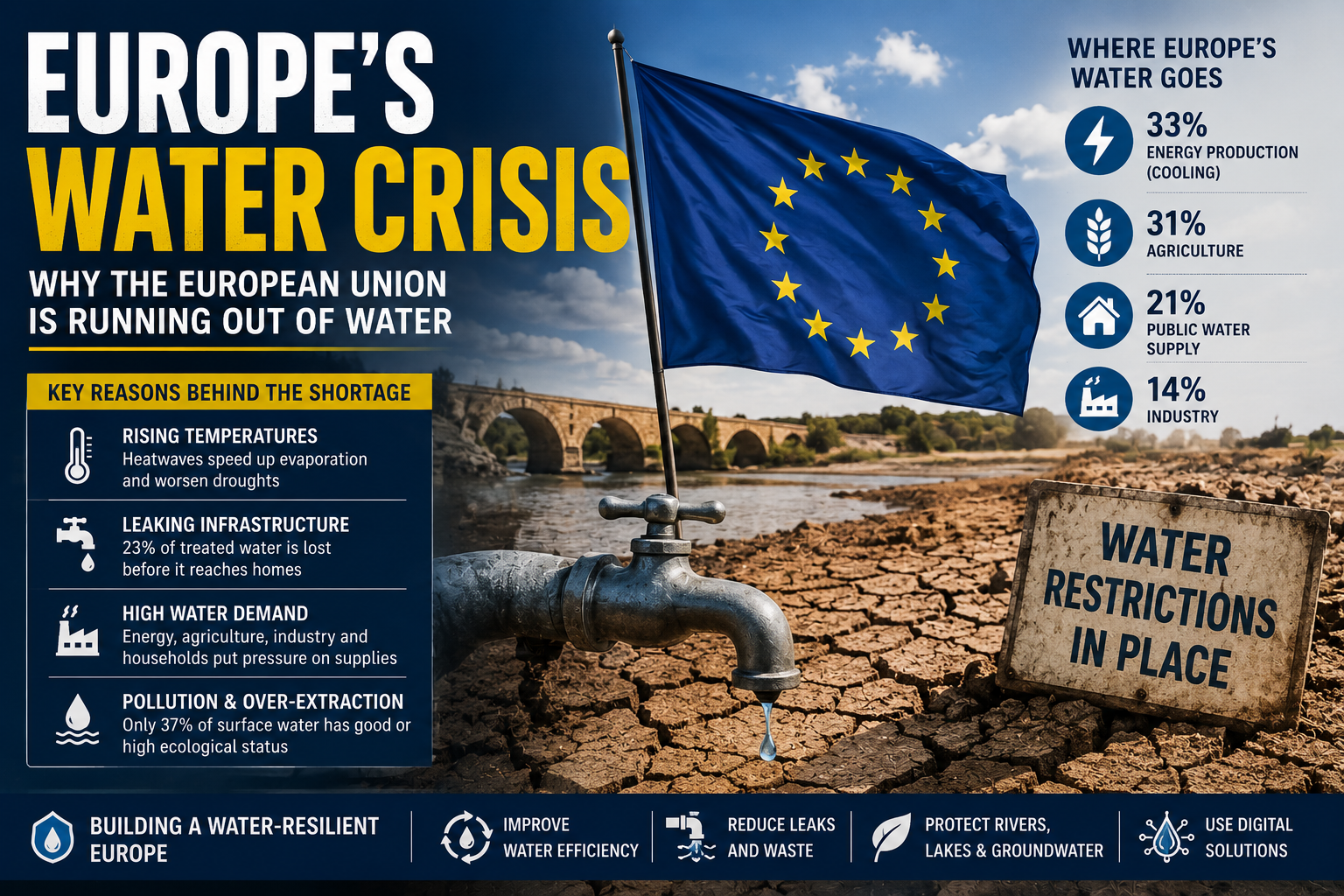
High temperatures can accelerate the loss of water from rivers, reservoirs, lakes and soil through evaporation.
When rainfall remains below normal levels for extended periods, natural water systems struggle to recover. This can reduce supplies for households, farms, businesses and energy producers at the same time.
Climate change is adding another layer of uncertainty. More frequent periods of extreme heat and changing rainfall patterns are making it harder for some European regions to maintain reliable water reserves throughout the year.
Water is needed across almost every major part of Europe’s economy.
Energy production is one of the largest users, particularly because power plants require water for cooling. Agriculture also places substantial demands on freshwater resources, while households and industry account for significant portions of overall consumption.
This creates a difficult challenge for policymakers. Cutting water use in one sector can affect food production, electricity generation, industrial activity or everyday household needs.
The problem becomes more complicated when demand rises during periods when natural supplies are already declining.
A significant amount of treated water never reaches consumers because of losses within ageing distribution networks.
Leaking pipes can waste valuable supplies before water reaches homes, farms or businesses. In some areas, infrastructure investment has not kept pace with the need to repair and modernise water networks.
Reducing these losses could therefore provide one of the quickest opportunities to improve water efficiency without necessarily reducing essential services.
Modernising pipelines, improving monitoring systems and detecting leaks earlier could help European countries preserve millions of litres of water.
Europe’s challenge is not only about how much water is available.
The condition of rivers, lakes and groundwater is equally important. Pollution and excessive extraction can damage aquatic ecosystems and reduce the amount of water suitable for human and environmental use.
Lower water levels can also make pollution more concentrated, creating additional pressure on ecosystems and water-treatment systems.
Protecting water quality is therefore becoming an increasingly important part of Europe’s broader water-security strategy.
Read Also: Spain Plans Border Checks on Travellers From Italy Amid Growing Migration Dispute
The European Union has been developing policies aimed at making its water system more resilient to climate change and future shortages.
The bloc’s water-resilience approach focuses on improving efficiency, reducing unnecessary consumption, tackling pollution and protecting natural water resources.
One of the key ambitions is to improve water efficiency by at least 10% by 2030.
Digital technology is also expected to play a larger role. Better monitoring systems, data collection and smart water-management tools could help authorities identify shortages earlier and distribute resources more efficiently.
Agriculture is particularly exposed to water shortages because crops depend heavily on reliable supplies during periods of high temperatures.
Farmers may increasingly need to adopt water-efficient irrigation methods, change crop choices and improve soil management to reduce losses.
Energy production faces a different challenge. Some power facilities require large quantities of water for cooling, meaning drought and low river levels can affect electricity generation.
This creates a difficult policy question: how should limited water supplies be shared between essential sectors?
Experts and policymakers are increasingly focusing on a combination of short-term conservation and long-term investment.
Potential measures include:
No single measure is likely to solve the problem. European countries will need to combine infrastructure improvements with changes in consumption and stronger protection of natural water resources.
Water shortages can affect much more than drinking-water supplies.
Agriculture, food prices, energy production, industry, tourism and ecosystems can all be affected when water becomes scarce.
The economic consequences could become more significant if drought conditions become more frequent or last longer.
For European governments, the challenge is increasingly about preparing for a future in which reliable access to water can no longer be taken for granted.
The EU’s water challenge is likely to become a long-term policy issue rather than a temporary summer problem.
Extreme heat may bring immediate attention to drought and restrictions, but reducing Europe’s vulnerability will require years of investment and changes in how water is managed.
Better infrastructure, efficient agriculture, responsible industrial use and stronger environmental protection could all help reduce pressure on the continent’s limited supplies.
Europe’s growing water shortage is the result of several pressures coming together. Extreme heat and drought are making the situation more urgent, but ageing infrastructure, pollution, intensive consumption and declining natural reserves have been building the problem for years.
The European Union now faces the challenge of protecting water supplies while maintaining agriculture, energy production, industry and everyday life.
How effectively Europe responds will determine whether future water shortages remain manageable or become a much larger economic and environmental crisis.




[…] Read Also: Europe’s Water Crisis Deepens as Heat, Drought and Rising Demand Put Supplies Under Pressure […]