Physical Address
304 North Cardinal St.
Dorchester Center, MA 02124

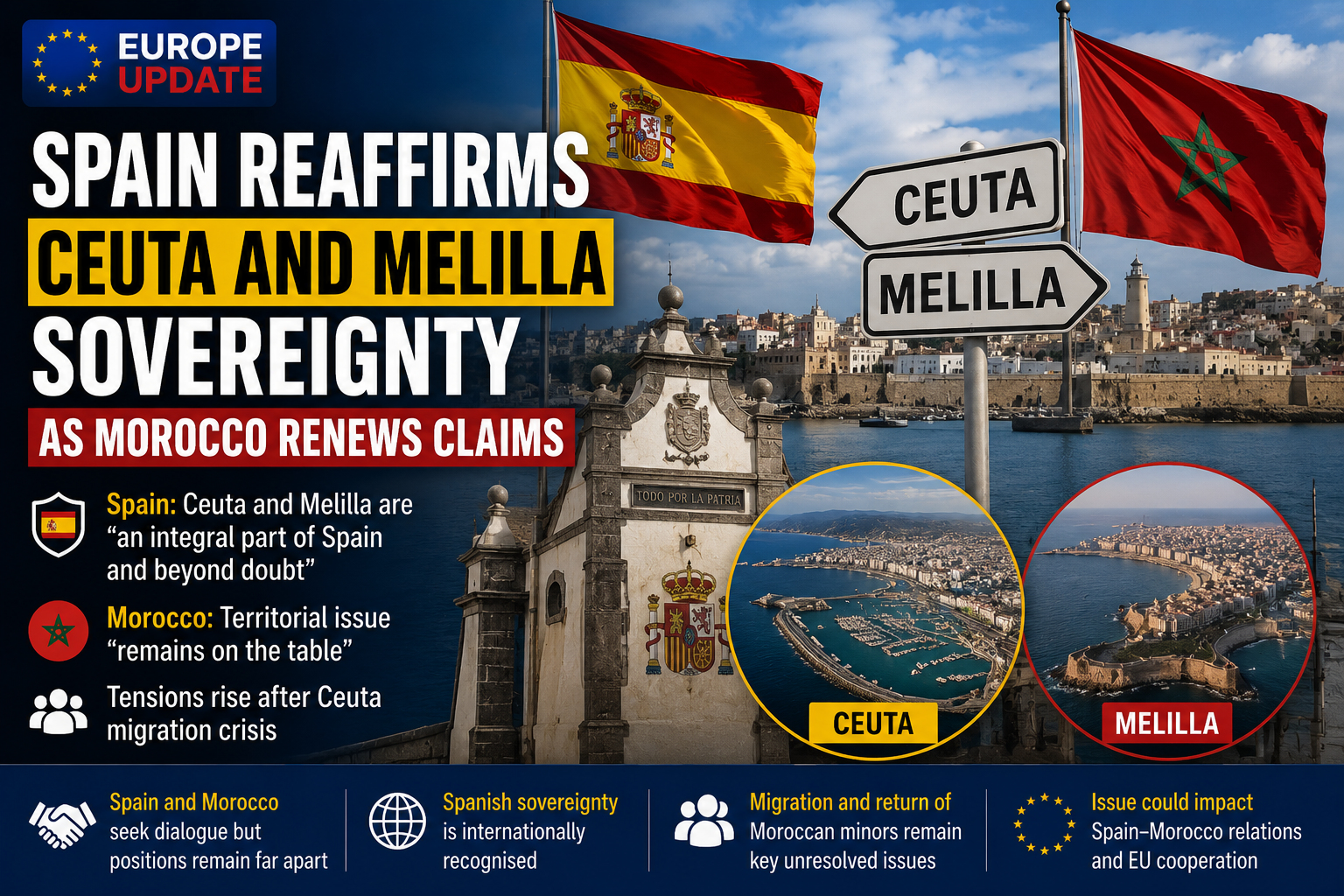
Spain has reaffirmed that its sovereignty over Ceuta and Melilla is not open to negotiation, as diplomatic tensions with Morocco continue following the recent migration crisis in the Spanish enclaves.
Spanish diplomatic sources told Euronews that both territories are an integral part of Spain and that Madrid has no intention of discussing their status with Morocco.
The statement comes after Moroccan Justice Minister Abdellatif Ouahbi said the question of Ceuta and Melilla remains a pending issue in discussions between Madrid and Rabat.
Read Also: Colombia Earthquake: Three Days of Mourning as EU Sends Emergency Aid
Spanish officials have delivered a clear message that the country’s sovereignty over Ceuta and Melilla will not be questioned.
The two autonomous cities, located on the North African coast, have been under Spanish control for centuries and remain internationally recognised as Spanish territory.
Spanish diplomatic sources stressed that the country’s territorial integrity “has never been and will never be discussed” with another government.
The comments come at a sensitive moment, following a major migration crisis in Ceuta that has increased political and diplomatic pressure between Spain and Morocco.
Spain’s Defence Minister Margarita Robles has also attempted to reassure residents of Ceuta and underline the government’s commitment to protecting the territory.
During a recent visit, Robles said the Spanish military would continue supporting the population and made clear that Ceuta and Melilla were firmly part of Spain.
Her remarks came amid concerns about another possible attempt by large numbers of migrants to enter Ceuta.
Spanish authorities have maintained a military presence in the area while security forces continue monitoring the situation along the border.
Moroccan Justice Minister Abdellatif Ouahbi has taken a different position.
In an interview with Saudi broadcaster Asharq News, Ouahbi described the status of Ceuta and Melilla as a pending issue between Morocco and Spain.
He said the subject remains part of discussions between officials from the two countries and maintained that Morocco continues to pursue its territorial claims through dialogue.
The comments represent a renewed focus on an issue that has the potential to complicate relations between the two neighbours.
The latest disagreement comes less than two weeks after a major migration crisis in Ceuta.
Large numbers of migrants attempted to cross from Morocco into the Spanish enclave, creating a significant challenge for Spanish security forces and local authorities.
The situation also raised questions about the treatment and future of Moroccan minors who remained in Ceuta following the crossings.
Moroccan officials have called for the minors to be returned to Morocco and reunited with their families.
Ouahbi argued that Morocco has a responsibility to protect its children and rejected the idea that Moroccan minors should remain in Spain for demographic or economic reasons.
The status of Ceuta and Melilla is only one of several sensitive issues between Spain and Morocco.
Migration management, extradition arrangements and the treatment of Moroccan citizens in Spain have also become important areas of discussion.
The latest comments from Rabat could therefore make diplomatic negotiations more difficult at a time when both governments are attempting to manage the consequences of the Ceuta crisis.
Spain, however, appears determined to separate discussions over migration and bilateral cooperation from what it considers a non-negotiable question of national sovereignty.
The Moroccan justice minister also rejected suggestions that migration was deliberately used to put political pressure on Spain.
Ouahbi said Morocco continued to defend its territorial position but insisted that the country wanted disputes to be resolved through dialogue rather than confrontation.
His comments come as both governments face pressure to explain how the recent migration crisis developed and how similar incidents could be prevented in the future.
The future of Spain-Morocco relations could depend heavily on how the two countries handle the aftermath of the Ceuta crisis.
Madrid is expected to maintain heightened security around Ceuta and Melilla while continuing diplomatic contacts with Rabat.
Morocco, meanwhile, is likely to keep its position on the two Spanish enclaves while seeking negotiations on migration, the return of minors and other bilateral matters.
For Spain, however, the message remains unequivocal: Ceuta and Melilla are considered part of the country’s territorial integrity, and Madrid does not intend to reopen the question of sovereignty.
Read Also: US Appeals Court Allows Social Media Addiction Lawsuits Against Big Tech to Continue
The renewed dispute over Ceuta and Melilla highlights the complicated relationship between Spain and Morocco. While both sides continue to emphasise dialogue, their positions on the sovereignty of the two enclaves remain fundamentally different.
With migration, border security and the future of Moroccan minors still unresolved, the coming weeks could prove important for relations between Madrid and Rabat.





[…] Read Also: Spain Reaffirms Ceuta and Melilla Sovereignty as Morocco Renews Claims […]
[…] Read Also: Spain Reaffirms Ceuta and Melilla Sovereignty as Morocco Renews Claims […]