Physical Address
304 North Cardinal St.
Dorchester Center, MA 02124
Physical Address
304 North Cardinal St.
Dorchester Center, MA 02124

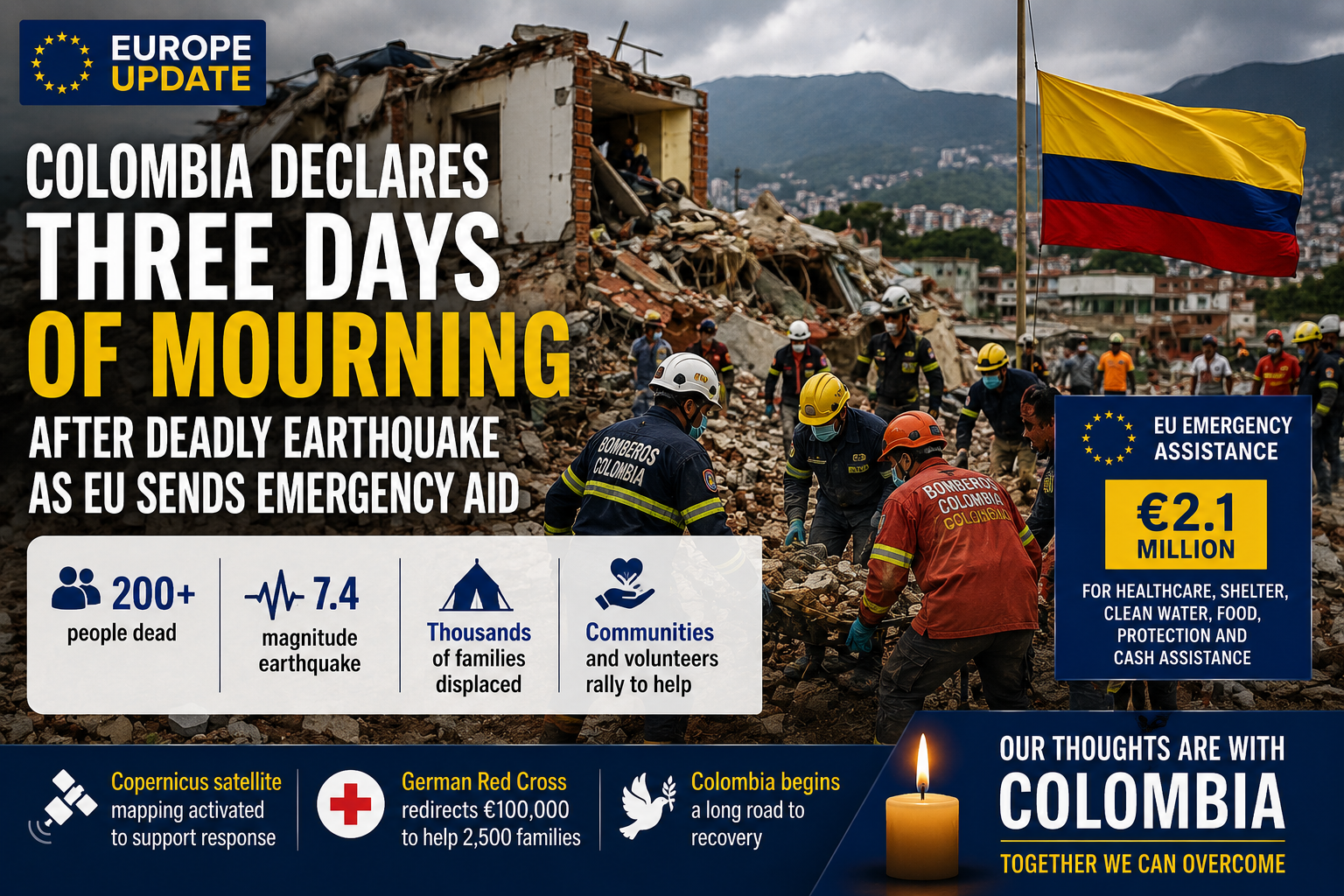
Colombia has declared three days of national mourning following a powerful earthquake that caused widespread destruction in western parts of the country and left more than 200 people dead.
The 7.4-magnitude earthquake, which struck on Monday, damaged homes, public buildings and critical infrastructure in several communities. Emergency teams are continuing to search collapsed structures as authorities assess the full scale of the disaster.
The Colombian government ordered flags to be flown at half-staff at official buildings and diplomatic missions during the mourning period as the country honours those who lost their lives.
Search and rescue operations remain the immediate priority across the worst-affected areas.
Emergency crews have been using cranes, heavy machinery and specially trained dogs to search through collapsed buildings. Local residents have also joined rescue efforts, clearing smaller pieces of debris by hand and helping emergency workers reach damaged neighbourhoods.
The first few days after a major earthquake are considered critical for locating survivors who may remain trapped beneath rubble. Rescue teams are therefore working continuously while engineers assess whether damaged structures can be safely entered.
The discovery of survivors has provided moments of hope amid the destruction, although officials continue to warn that the situation remains extremely difficult.
Read Also: US Appeals Court Allows Social Media Addiction Lawsuits Against Big Tech to Continue
The earthquake has placed considerable pressure on Colombia’s healthcare system.
Some medical facilities were damaged, forcing healthcare workers to move patients and treatment areas outside buildings. Emergency treatment has been carried out in open spaces while authorities attempt to maintain essential medical services.
Hospitals in affected areas have also faced increased demand for emergency treatment as injured residents arrive from damaged communities.
At the same time, blood donation centres have received large numbers of people willing to help, while volunteers have delivered food, water and other supplies to neighbourhoods affected by the disaster.
The destruction has left many residents unable to return to their homes.
Some buildings have been severely damaged, while others are being inspected because of concerns about structural stability. Many families have chosen to sleep outdoors because they fear further tremors and aftershocks.
Temporary shelters have been established in public spaces, providing displaced residents with mattresses, food and other basic necessities.
For families who have lost their homes, the emergency is likely to continue well beyond the initial rescue operation.
Colombian authorities have declared a state of emergency as the government coordinates the national response.
Officials are assessing damaged infrastructure and identifying areas where emergency assistance is most urgently required.
The immediate priorities include finding survivors, treating injured people, providing temporary accommodation and ensuring that affected communities have access to food, drinking water and medical supplies.
The government is also expected to face a longer-term challenge of rebuilding damaged homes and public infrastructure once the rescue phase ends.
International support is now reaching Colombia as the scale of the disaster becomes clearer.
The European Union has announced €2.1 million in emergency humanitarian assistance following the earthquake. The funding is intended to help provide healthcare, water, sanitation and hygiene supplies, shelter, food, protection and cash assistance to vulnerable communities.
The EU has also activated its civil protection response following Colombia’s request for assistance.
For readers who want to verify the EU’s response directly, the European Commission’s official humanitarian aid announcement provides details about the emergency funding and assistance being delivered on the ground:
European Commission: EU emergency assistance to Colombia
European assistance also includes technological support.
The EU has activated its Copernicus satellite mapping service, which can provide authorities and emergency teams with information about damaged areas and support initial assessments following the earthquake.
Satellite mapping can be particularly valuable after major disasters because it allows emergency planners to identify affected locations and improve the coordination of rescue and humanitarian operations.
The European Commission said its humanitarian partners were already working in affected areas.
The German Red Cross, one of the EU’s humanitarian partners, has redirected €100,000 from an EU-funded project to address immediate needs among around 2,500 affected families in Chocó and Valle del Cauca.
Despite the destruction, communities across the affected regions have responded with large-scale volunteer efforts.
Residents have helped rescue workers remove debris, transport essential supplies and support families who have been displaced.
Blood donation centres have also attracted people eager to contribute to the emergency response.
Such community efforts are particularly important during the first days of a major disaster, when emergency services can quickly become overwhelmed by the scale of demand.
The rescue operation remains the most urgent task, but Colombia is already facing the difficult challenge of planning for recovery.
Authorities will need to inspect thousands of buildings, identify homes that can no longer be occupied and establish longer-term accommodation for displaced families.
Infrastructure such as hospitals, roads and public buildings will also require detailed assessments before reconstruction can begin.
The economic impact could be significant, particularly for families and small businesses in communities where buildings and essential services have been badly damaged.
The European Union has indicated that it remains ready to provide further assistance as Colombia’s needs become clearer.
International humanitarian organisations and national authorities are expected to continue assessing the situation over the coming days.
The focus will gradually move from immediate rescue operations toward temporary housing, healthcare, infrastructure repair and longer-term recovery.
Read Also: Latvia Strengthens Belarus Border Security as Irregular Migration Increases
The earthquake has brought devastation to communities across western Colombia, but rescue workers and volunteers continue to search for survivors while emergency services provide support to those who have lost homes and loved ones.
The three-day mourning period gives the country an opportunity to honour the victims, while the ongoing emergency response focuses on saving lives and helping survivors.
With assistance from international partners including the European Union, Colombia is now beginning what could be a long and difficult recovery process.



[…] Read Also: Colombia Earthquake: Three Days of Mourning as EU Sends Emergency Aid […]