Physical Address
304 North Cardinal St.
Dorchester Center, MA 02124
Physical Address
304 North Cardinal St.
Dorchester Center, MA 02124
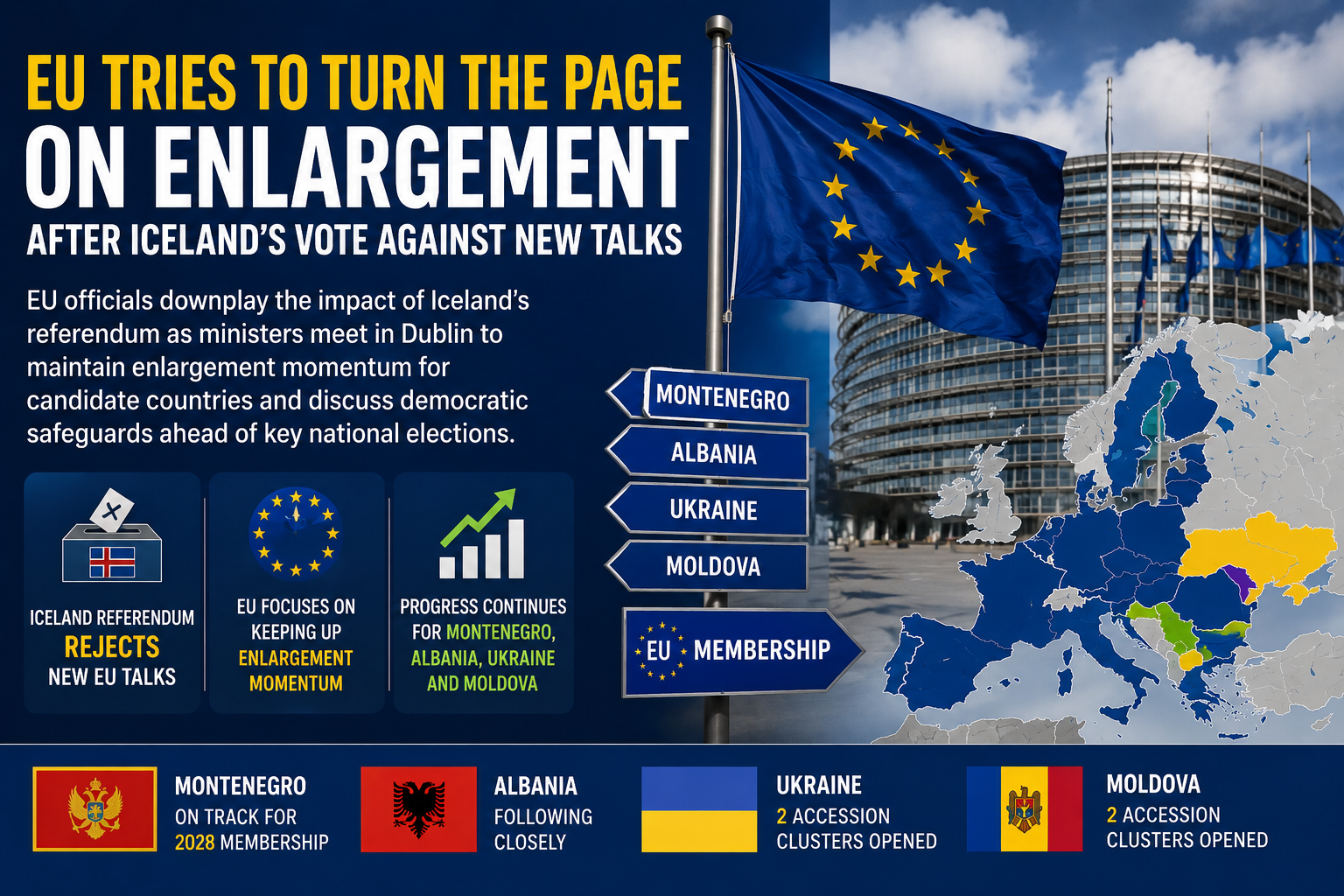
European Union officials are seeking to maintain momentum behind the bloc’s enlargement plans after Icelandic voters narrowly rejected a proposal to restart membership negotiations with Brussels.
The referendum result has raised questions about the EU’s appeal, particularly among wealthy European countries that already enjoy close economic and travel links with the bloc. However, EU leaders and ministers meeting in Dublin on Friday insisted that Iceland’s decision would not derail the accession process for other candidate countries.
Icelandic voters rejected the reopening of EU membership talks by 52.8% to 47.2%. Negotiations between Iceland and the EU had been suspended since 2013.
The vote was seen as a setback for Brussels, which has increasingly presented enlargement as an important part of Europe’s economic and security strategy. Iceland is already part of the European Economic Area and the Schengen travel zone, but EU officials argue that membership offers much deeper political and strategic cooperation.
European Commissioner for Enlargement Marta Kos said the referendum should not be interpreted as evidence that the European Union has become less attractive.
Speaking during an informal meeting of European affairs ministers in Dublin, Kos said significant progress had been made on enlargement in recent months.
“More progress has been made in the past eight months than in the previous 25 years,” she said, while acknowledging that she regretted Iceland’s decision.
Kos argued that the EU should not be viewed only as an economic community. She said the bloc’s political unity and collective security were becoming increasingly important as Europe faces growing threats, including pressure from Russia.
“Icelandic people voted the way they did. What can we do? They made the decision,” Ireland’s Minister of State for European Affairs and Defence, Thomas Byrne, said.
Byrne added that Iceland’s decision would not affect the work being carried out by other candidate countries.
EU ministers used the Dublin meeting to highlight progress made by countries seeking membership.
Montenegro is considered to be the leading candidate and could become the EU’s 28th member by 2028 if it completes the remaining reforms and negotiations. Albania is also advancing through the accession process.
Ukraine and Moldova have opened two accession clusters this year, marking progress despite the political and security challenges facing both countries.
Byrne said Iceland’s referendum was linked to specific national concerns, particularly the future of its fishing industry. He also noted that Iceland would remain closely connected to the European market through its existing relationship with the European Economic Area.
The Irish minister rejected suggestions that upcoming elections in several EU countries could threaten enlargement plans. National elections are scheduled in countries including France, Italy, Spain and Poland in 2027.
“Elections are unpredictable,” Byrne said, warning against drawing firm conclusions from current opinion polls.
Alongside enlargement, EU ministers are discussing new safeguards designed to prevent democratic and rule-of-law problems after countries join the bloc.
The European Commission is preparing a proposal on how the EU could function after further expansion and how candidate countries could be gradually integrated. The proposal is expected to be published later this month and discussed by EU leaders at a summit scheduled for 15–16 October.
The discussion follows concerns that some member states have weakened democratic institutions and failed to respect the rule of law after joining the EU.
Five founding EU members have called for stronger safeguards for future members, drawing lessons from the long tenure of former Hungarian Prime Minister Viktor Orbán.
Kos said the EU could not always guarantee that new members would continue respecting democratic standards and the principle of sincere cooperation after accession.
However, she rejected the idea that the proposed safeguards would create a permanent second tier of membership. According to Kos, any restrictions would need to be temporary and based on clear conditions.
Montenegro has expressed support for stronger protections, provided that the measures are based on objective and transparent criteria.
Petar Marković, Montenegro’s head of mission to the EU, said his country supported safeguards aimed at preventing systematic breaches of democratic and rule-of-law standards.
The debate reflects a wider challenge for the EU: expanding the bloc while ensuring that new members meet its political and legal requirements.
For Brussels, the Icelandic referendum is a reminder that membership cannot be taken for granted, even among countries that already have close economic ties with the EU. Nevertheless, officials remain determined to advance enlargement as a long-term strategic priority.
The EU’s immediate focus will now remain on countries already progressing through the accession process, particularly Montenegro, Albania, Ukraine and Moldova.