Physical Address
304 North Cardinal St.
Dorchester Center, MA 02124
Physical Address
304 North Cardinal St.
Dorchester Center, MA 02124

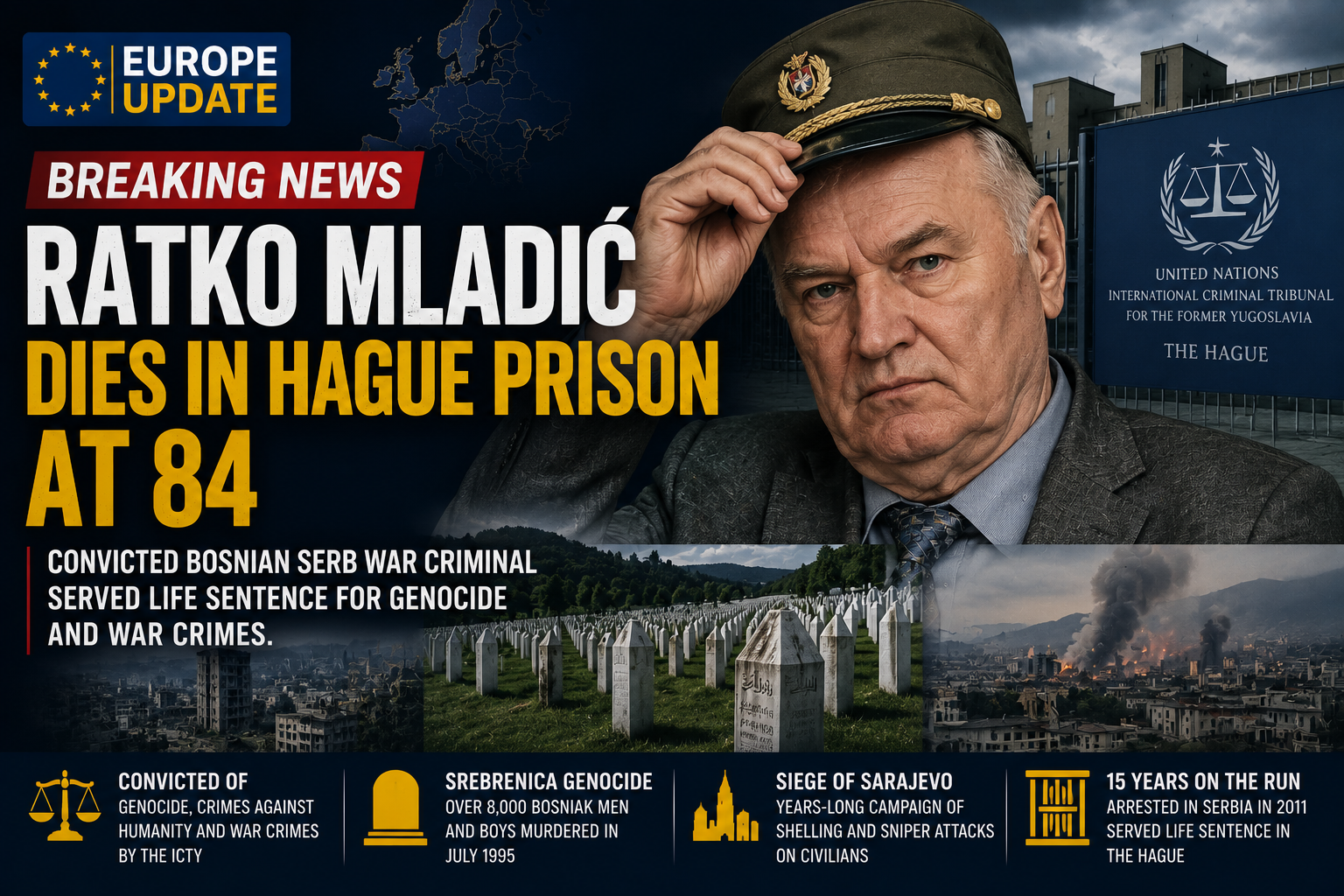
Former Bosnian Serb military commander and convicted war criminal Ratko Mladić has died at the age of 84 while serving a life sentence in The Hague. His death marks the end of a major chapter in the history of the Bosnian War and international criminal justice.
Mladić was one of the most prominent figures prosecuted for atrocities committed during the Bosnian War in the 1990s. He was convicted of genocide, crimes against humanity and war crimes for his role in some of the conflict’s worst atrocities, including the 1995 Srebrenica genocide and the prolonged siege of Sarajevo.
Mladić served as the military commander of Bosnian Serb forces during the war that followed Bosnia and Herzegovina’s declaration of independence from Yugoslavia in 1992.
The conflict quickly developed into one of the bloodiest wars in Europe since World War II. Bosnian Serb military forces fought against Bosniak and Croat forces as competing political and military groups struggled for control of territory.
Under Mladić’s command, Bosnian Serb forces were accused and later convicted in relation to widespread campaigns of persecution, forced displacement, killings and attacks against civilians.
His name became closely associated with the ethnic cleansing campaigns carried out during the conflict, making him one of the most internationally recognised figures connected to the Bosnian War.
For more information about the legal proceedings and history of the case, readers can review the Ratko Mladić case information and timeline maintained by the international tribunal system.
The most serious crime for which Mladić was convicted was his role in the Srebrenica genocide in July 1995.
More than 8,000 Bosniak men and boys were killed or went missing after Bosnian Serb forces captured the UN-declared safe area. The massacre was later recognised by international courts as genocide.
Mladić was found responsible for his role in the military operations and crimes committed by forces under his command.
The Srebrenica genocide remains one of the darkest chapters in modern European history and one of the gravest atrocities committed in Europe since the Second World War.
Readers can learn more about the historical background and victims through the United Nations overview of the 1995 Srebrenica genocide.
Mladić was also convicted for crimes connected to the siege of Sarajevo, which lasted for several years during the Bosnian War.
Bosnian Serb forces positioned around the city subjected Sarajevo to sustained shelling and sniper attacks. Thousands of civilians were killed or injured during the siege, while residents faced severe shortages and years of uncertainty.
The siege became an international symbol of the suffering experienced by civilians during the conflict.
International prosecutors found that the campaign involved terror and unlawful attacks against civilians in Sarajevo. The international tribunal’s Siege of Sarajevo historical record provides further information about the cases and convictions connected to the siege.
Mladić was indicted by the International Criminal Tribunal for the former Yugoslavia in 1995 but remained at large for many years.
After leaving his military position, he spent approximately 15 years as a fugitive.
He was eventually arrested in Serbia in 2011, bringing an end to one of the longest and most closely watched manhunts connected to the Balkan wars.
His arrest was seen as a major moment for international justice and opened the way for his prosecution in The Hague. The official ICTY case archive for Ratko Mladić contains documents and records relating to the prosecution.
Following a lengthy trial, Mladić was convicted and sentenced to life imprisonment.
The verdict found him responsible for genocide in Srebrenica as well as crimes including persecution, extermination, murder, forcible transfer, terror and unlawful attacks on civilians.
His case became one of the most significant prosecutions handled by the international tribunal established to investigate crimes committed during the wars in the former Yugoslavia.
Mladić spent his final years in custody in The Hague, with reports indicating that his health had deteriorated significantly in recent years.
The death of Ratko Mladić marks the end of the life of one of the most notorious military figures from the wars that followed the collapse of Yugoslavia.
However, the consequences of the Bosnian War continue to shape politics, communities and relations across the Balkans.
For survivors and families of victims, the crimes committed during the conflict remain a deeply painful part of their lives. The Srebrenica genocide and the siege of Sarajevo continue to stand as powerful reminders of the human cost of war and ethnic violence.
The United Nations continues to highlight the importance of remembering the victims and addressing genocide denial and the glorification of convicted war criminals. More information is available through the UN’s Srebrenica remembrance and commemoration page.
Mladić’s conviction remains an important chapter in the history of international criminal justice, demonstrating the long process involved in investigating and prosecuting those responsible for major wartime atrocities.
As Bosnia and Herzegovina and the wider Balkan region continue to deal with the legacy of the 1990s conflicts, the memory of the victims remains at the centre of efforts to preserve historical truth and prevent similar atrocities from happening again.