Physical Address
304 North Cardinal St.
Dorchester Center, MA 02124
Physical Address
304 North Cardinal St.
Dorchester Center, MA 02124

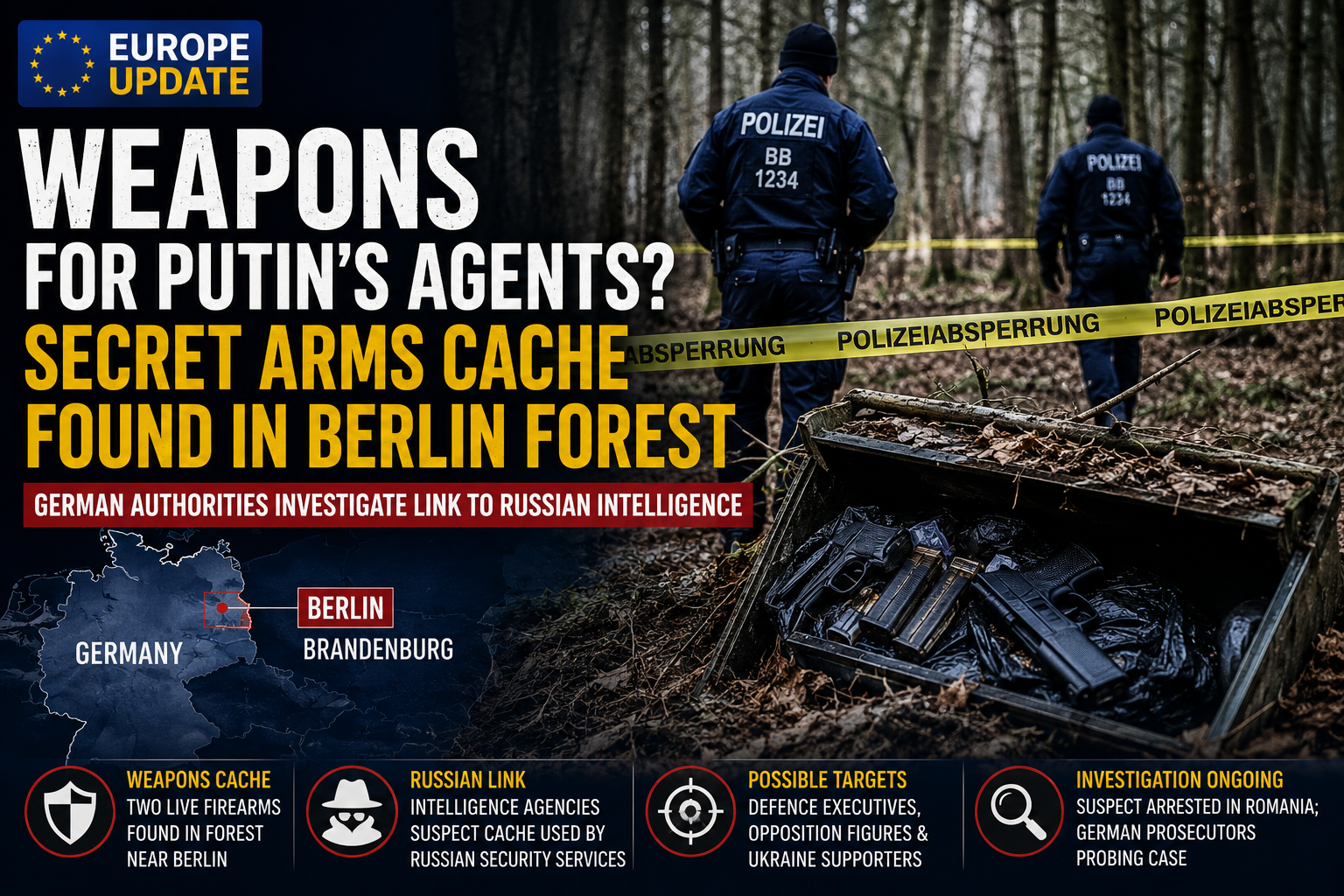
German security authorities are investigating a professionally prepared weapons cache discovered in a forest near Berlin after evidence reportedly linked the site to suspected Russian intelligence activity.
The discovery has raised concerns about whether Moscow-linked operatives may have been preparing for violent operations inside Germany. According to reporting by German broadcasters NDR and WDR and Süddeutsche Zeitung, investigators found two operational firearms hidden in the Brandenburg woodland.
Read Also: Russia Faces New Petrol Shortages as Ukrainian Strikes Hit Oil Refineries

The cache was reportedly discovered after German authorities received information about a concealed depot in woodland near the capital.
Rather than resembling an ordinary illegal weapons stash, investigators reportedly found a professionally organised hiding place. German security officials are examining whether it was established as a so-called “dead letterbox” — a covert location where agents can leave weapons, equipment or information for another operative to collect later.
Authorities believe the weapons may have been intended for people acting on behalf of Russian intelligence, although the investigation is still ongoing and the allegations have not been publicly confirmed by German officials.
The most serious aspect of the case is the suspected connection to Russian security services.
Germany’s domestic intelligence agency, the Federal Office for the Protection of the Constitution (BfV), reportedly believes there are indications that the cache was established for Russian agents.
Investigators are examining whether the weapons could have been intended for what German authorities describe as “kinetic operations” — a term used to describe acts involving physical violence.
Potential targets mentioned in reporting include people connected to Germany’s defence sector, Russian opposition figures living abroad and individuals supporting Ukraine.
However, it is important to distinguish between what investigators suspect and what has been proven in court. There has been no public confirmation that the weapons were actually used in an attack or that a specific Russian agency ordered their placement.
According to reports, German investigators did not immediately remove the entire operation from the site.
The weapons were reportedly rendered unusable and the location was monitored in an attempt to identify anyone who might return to collect them.
That approach reflects the wider intelligence challenge facing German authorities: discovering a weapons cache may be only the first step in identifying the network behind it.
Reports say a suspect was later arrested in Romania and could be connected to the establishment of the hiding place. The German Federal Public Prosecutor’s Office is reportedly investigating the case over suspicions of preparing a serious act of violence threatening the state.
The discovery comes amid heightened German concerns about Russian espionage, sabotage and other covert activities.
Berlin has repeatedly warned that Russia could seek to use covert networks to disrupt critical infrastructure, influence political debates or target individuals connected to support for Ukraine.
The weapons cache therefore carries significance beyond the firearms themselves. If investigators establish a Russian intelligence connection, the case could provide further evidence of attempts to maintain operational networks inside Germany.
Germany’s domestic intelligence service has previously warned of the possibility of Russian-backed attacks, including potential assassinations targeting defence-industry figures and opponents of the Kremlin.
One of the biggest questions for investigators is who was expected to retrieve and use the weapons.
A dead-letterbox system is designed to separate the person leaving material from the person collecting it. That makes such locations difficult to trace and can help intelligence networks reduce direct contact between operatives.
If the Berlin-area cache was established for that purpose, investigators will likely examine how the weapons entered Germany, who prepared the site and whether similar locations exist elsewhere.
Authorities will also look for evidence linking the cache to communications, travel movements or other suspected intelligence activity.
The Russian embassy in Berlin has so far not publicly responded to the specific allegations surrounding the weapons cache, according to reports. Previous accusations involving Russian intelligence activity in Germany have been rejected by Russian officials.
German security authorities have also been cautious about publicly discussing operational intelligence.
The BfV has reportedly declined to comment on the specific case, consistent with its general policy of not publicly confirming or denying individual intelligence operations.
The case arrives at a sensitive time for European security.
Germany remains one of Ukraine’s most important European supporters, while Russia continues to view Western military and political assistance to Kyiv as a major strategic challenge.
That environment has increased concerns that confrontation between Russia and European states could extend beyond the battlefield in Ukraine.
For German authorities, preventing sabotage and politically motivated violence has therefore become an increasingly important part of national security planning.
Read Also: Spain Reaffirms Ceuta and Melilla Sovereignty as Morocco Renews Claims
The discovery of two firearms does not by itself establish that an attack was imminent. Investigators still need to determine who placed the weapons there, who they were intended for and whether the cache formed part of a wider network.
The reported arrest of a suspect in Romania could provide investigators with additional information about the origins of the depot and its intended purpose.
For now, the case remains an investigation rather than proof of a completed Russian-directed operation.
But if the suspected intelligence link is confirmed, the weapons cache near Berlin could become another significant case in Germany’s growing investigation into alleged Russian espionage and covert operations.