Physical Address
304 North Cardinal St.
Dorchester Center, MA 02124

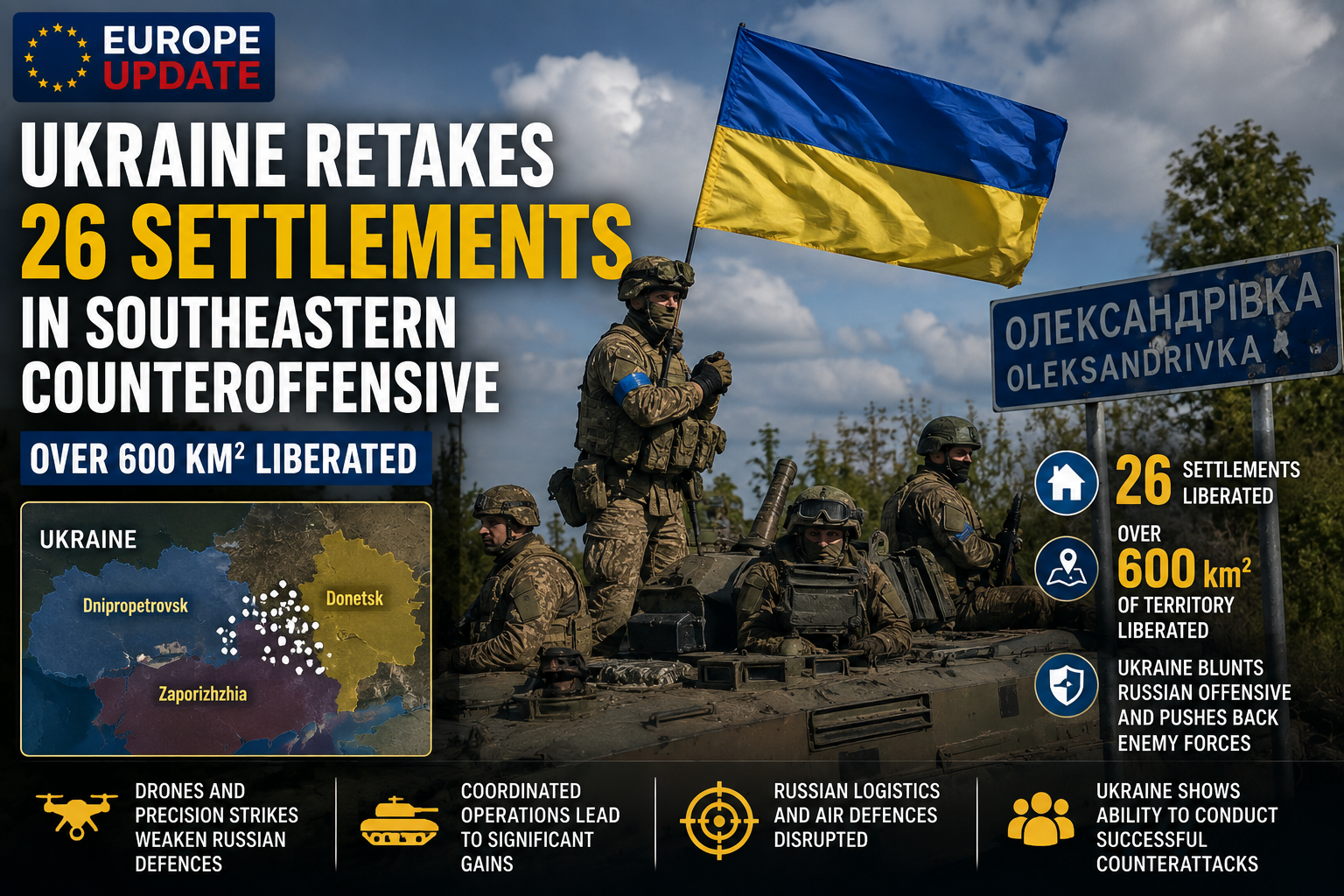
Ukraine says its forces have regained control of 26 settlements and more than 700 square kilometres of territory during a major counteroffensive in southeastern Ukraine.
According to Ukrainian officials, the operation in the Oleksandrivka direction lasted more than six months and was designed to disrupt Russia’s offensive plans and push Russian forces away from parts of Dnipropetrovsk, Donetsk and Zaporizhzhia regions.
Ukraine’s Air Assault Forces Command says its troops have liberated more than 745 square kilometres and retaken 26 settlements. Reuters reported that Ukrainian President Volodymyr Zelenskyy also announced the 745-square-kilometre figure, while independent battlefield mapping has produced more conservative estimates.
Read Also: Hungary Takes Steps to Unlock Frozen EU Funds With New Procurement Rules
The 26 settlements reported as liberated are spread across three Ukrainian regions.
According to Ukrainian authorities:
The area is strategically important because it connects several sectors of the southern and eastern battlefield.
Kyiv says the operation was intended to weaken Russia’s spring and summer offensive and prevent Russian forces from expanding their positions toward Dnipropetrovsk.
While Ukrainian officials report more than 745 square kilometres of gains, independent battlefield assessments have produced a lower figure.
The Institute for the Study of War (ISW) assessed the Ukrainian advance at roughly 626.69 square kilometres across the Oleksandrivka direction and the northern edge of the neighbouring Hulyaipole sector.
ISW said its methodology may underestimate Ukrainian advances, highlighting the difficulty of accurately measuring territorial changes during an active war. Its assessment also described the operation as evidence that Ukrainian forces remain capable of conducting relatively significant, coordinated counterattacks.
The reported gains are significant because much of the war has been characterised by slow and highly attritional fighting.
Ukraine’s operation demonstrates how its forces are combining drones, mechanised units, artillery, intelligence and strikes against Russian logistics to create opportunities for advances.
The operation also puts pressure on Russian commanders, who must decide where to deploy troops and equipment to reinforce vulnerable sectors.
Drone warfare has become one of the defining elements of the conflict.
Ukrainian forces increasingly use drones for reconnaissance, battlefield targeting and attacks against Russian positions. Longer-range strikes are also being used against command centres, ammunition storage sites and logistics infrastructure.
The ISW assessment highlighted Ukrainian efforts to suppress Russian air defences and disrupt Russian logistics as important factors behind the advances.
The Ukrainian gains could force Russia to make difficult strategic choices.
Reinforcing the Oleksandrivka area could require Moscow to move troops and equipment away from other parts of the frontline. Maintaining pressure elsewhere, meanwhile, could leave Russian positions in the southeastern sector more exposed.
This dilemma comes as Russia continues to face significant manpower and equipment demands across a very long frontline.
The reported operation stands out because large territorial breakthroughs have been relatively rare during the later stages of the war.
Minefields, fortified positions, drones and heavy artillery have made offensive operations extremely difficult for both sides.
The Ukrainian advance therefore represents an important local development, although it would be premature to describe it as a decisive turning point in the wider war.
Russia continues to control substantial areas of Ukrainian territory and retains considerable military capabilities.
Ukraine’s reported advances are taking place alongside Russian claims of territorial gains elsewhere.
On 15 August, Reuters reported that Russia’s Defence Ministry claimed its forces had captured 19 settlements in southeastern Ukraine during its summer campaign, although those claims had not been independently verified.
This highlights the complexity of the battlefield, where advances by one side in one sector can occur at the same time as fighting continues or territory changes elsewhere.
The most important question is whether Ukrainian forces can hold and consolidate the territory they have regained.
That will require establishing defensive positions, clearing mines, protecting supply routes and defending newly recovered settlements against possible Russian counterattacks.
Russia is also likely to attempt to slow further Ukrainian advances and reinforce threatened positions.
The coming weeks will therefore be important in determining whether the Oleksandrivka operation remains a localised Ukrainian success or develops into a broader shift along the southeastern front.
Read Also: Trump Confirms Secret Plane Switch in Turkey After Security Threat
The reported liberation of 26 settlements demonstrates that Ukraine retains the ability to conduct significant offensive operations despite years of intense fighting.
The operation also underlines the growing importance of drones, battlefield intelligence, air-defence suppression and attacks on military logistics.
However, the conflicting territorial estimates show why battlefield claims should be treated carefully until they can be independently verified.
For Kyiv, the immediate priority will be consolidating its gains. For Moscow, the challenge will be preventing the Ukrainian advance from creating further weaknesses elsewhere along the frontline.
The latest developments are an important moment for the southeastern front, but whether they develop into a larger strategic breakthrough remains uncertain.





[…] Read Also: Ukraine Retakes 26 Settlements in Major Southeastern Counteroffensive […]