Physical Address
304 North Cardinal St.
Dorchester Center, MA 02124
Physical Address
304 North Cardinal St.
Dorchester Center, MA 02124

By Europe Update Staff
Firefighters across Spain are continuing to battle several major wildfires, with authorities carrying out evacuations and restricting access to affected areas as strong winds, difficult terrain and changing conditions complicate emergency operations.
Two of the most closely watched fires are burning in Huelva, Andalusia, and Castellón in the Valencia region. Hundreds of residents have been evacuated or temporarily ordered to remain indoors as emergency crews work to prevent the flames from spreading further.
The situation highlights the continuing wildfire risk facing parts of Spain during the summer months.
Read Also: Spain Plans Border Checks on Travellers From Italy Amid Growing Migration Dispute
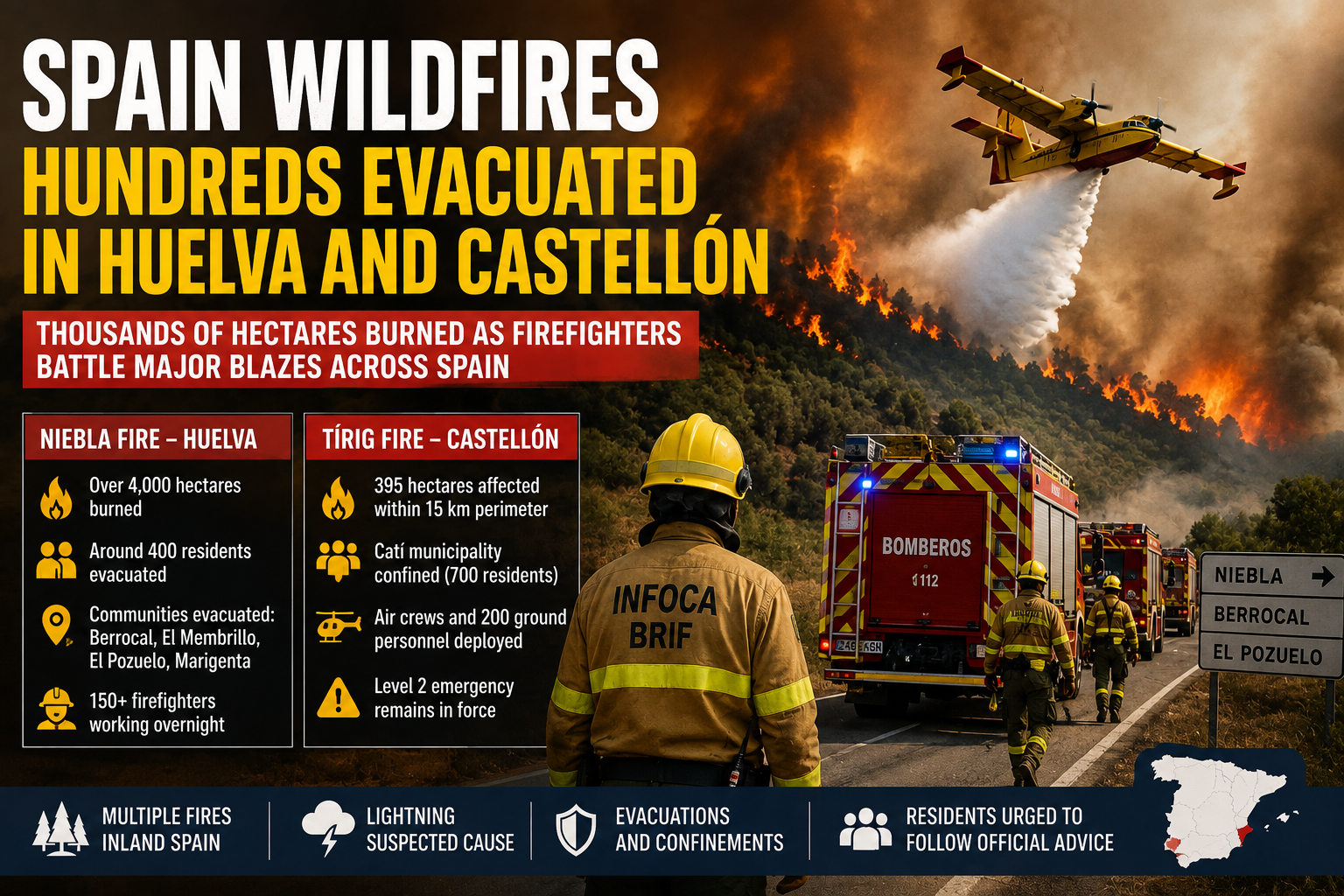
The most extensive blaze is near Niebla, west of Seville in Andalusia.
The fire began several days ago and has already affected more than 4,000 hectares of land. Authorities have evacuated around 400 residents from several nearby population centres as a precaution.
Communities affected by evacuation measures include Berrocal, El Membrillo, El Pozuelo and Marigenta.
More than 150 forest firefighters worked overnight in an effort to strengthen containment lines and slow the advance of the flames.
Emergency officials have described the operation as particularly challenging because winds have repeatedly changed direction. Burning embers can also travel ahead of the main fire, creating new hotspots and making containment more difficult.
The blaze remains under an elevated emergency classification while crews continue efforts to bring it under control.
Fire crews have been working through the night to protect populated areas and prevent the fire from reaching additional communities.
Authorities are closely monitoring weather conditions because wind speed and direction can have a major impact on the behaviour of large forest fires.
Regional and national officials are also coordinating their response. Spain’s ecological transition and emergency authorities are monitoring the situation as firefighting teams continue operations on the ground.
Another significant wildfire is burning near Tírig in Castellón, on Spain’s eastern coast.
The fire previously prompted authorities to order residents in Catí, a municipality with around 700 inhabitants, to remain indoors as a safety measure.
Airborne firefighting resources were deployed again at first light, joining approximately 200 ground personnel who had worked overnight.
The operation involves aircraft, emergency vehicles and specialist firefighting teams attempting to contain the flames across difficult terrain.
Authorities estimate that the Tírig fire has affected approximately 395 hectares within a perimeter stretching around 15 kilometres.
Emergency officials say the northern and southern sections of the Tírig fire require particular attention.
Although weather conditions could become more favourable, authorities have warned against declaring the fire stable too early.
Fire behaviour can change rapidly when temperatures, wind and humidity fluctuate, meaning crews must continue monitoring the affected area even when flames appear to weaken.
The blaze remains under a heightened emergency level while containment work continues.
The Tírig incident is part of a wider series of wildfires reported in inland Castellón.
Four fires were declared in the area during the same period, with provisional figures indicating that the combined affected area has reached several hundred hectares.
Investigators are examining possible causes. Initial indications suggest that lightning associated with thunderstorms may have triggered some of the fires.
However, the authorities are continuing their investigation before reaching a definitive conclusion.
There has also been progress in another fire near Sierra Engarcerán, south of Tírig.
Emergency authorities have reported that the blaze is now under control after affecting approximately 45 hectares.
The situation has improved sufficiently for authorities to lift the confinement order that had been imposed on the local population.
Around 91 residents who had been evacuated were able to return to their homes and rural properties. A further group of residents who had been temporarily accommodated at a sports facility also left the emergency shelter.
The latest fires come during a period when parts of Spain remain vulnerable to rapidly developing wildfires.
Dry vegetation, high temperatures and changing winds can create dangerous conditions for emergency services, particularly in forested and mountainous regions.
Authorities continue to advise residents in affected areas to follow evacuation and confinement orders and to rely on official emergency information rather than unverified reports circulating online.
Emergency teams are expected to continue operations in both Huelva and Castellón while officials assess weather forecasts and the condition of the fires.
For communities close to active fire zones, evacuation orders and access restrictions can change quickly depending on the direction of the flames.
Officials are therefore urging residents and visitors to follow instructions from emergency services and avoid entering restricted areas.
The wildfires in Huelva and Castellón have created a serious emergency across several parts of Spain, forcing hundreds of people from their homes and putting thousands of hectares of land at risk.
While firefighters have made progress in some areas, the Niebla and Tírig fires remain closely monitored. Changing winds, difficult terrain and dry conditions continue to present major challenges.
Authorities will now focus on strengthening containment lines, protecting nearby communities and preventing further expansion of the fires as emergency operations continue.





[…] Read Also: Wildfires Spread Across Spain as Hundreds Evacuated in Huelva and Castellón […]