Physical Address
304 North Cardinal St.
Dorchester Center, MA 02124
Physical Address
304 North Cardinal St.
Dorchester Center, MA 02124

By Europe Update Staff
Madrid Responds to Italy’s Temporary Border Measures
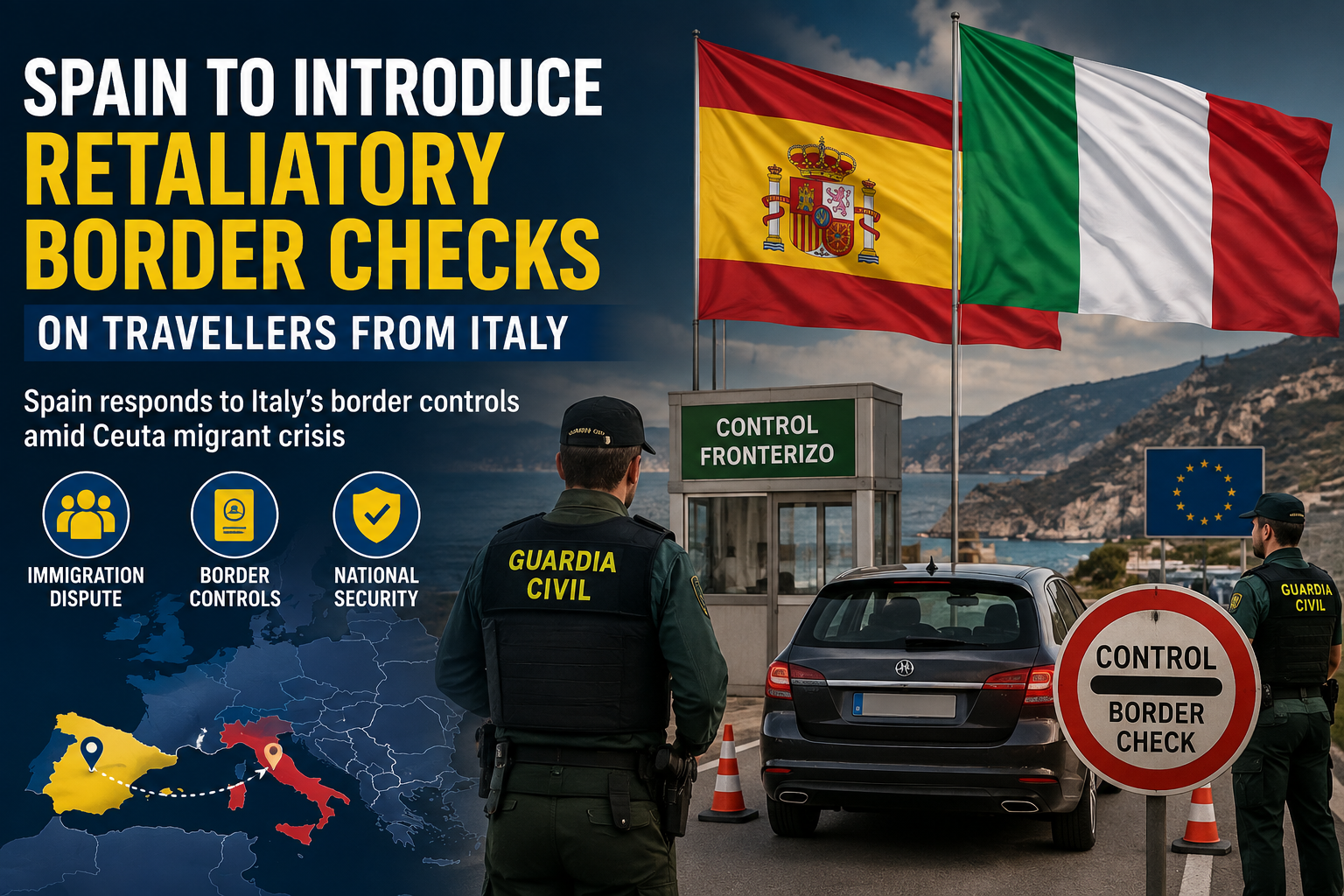
Spain is preparing to introduce temporary checks on travellers arriving from Italy, escalating a growing disagreement between the two European Union countries over migration and border controls.
The Spanish government said the new measures are a response to Italy’s decision to introduce checks affecting people travelling from Spain following the recent migration crisis in Ceuta.
According to Spain’s Interior Ministry, the reciprocal checks are scheduled to begin at midnight on Saturday and remain in place until 7 September 2026.
The dispute has raised fresh concerns about the future of free movement within Europe’s Schengen area.
Spanish authorities had previously called on Italy to remove its restrictions on travellers from Spain.
Madrid argued that Italy’s decision was inconsistent with European rules governing the Schengen border-free area and said the measures unfairly affected Spanish citizens.
Spain also warned that it could take proportionate action if Italy failed to withdraw the controls.
The Spanish government has now confirmed that it will introduce its own temporary measures.
Read Also: Disney and White House Face Backlash Over Spider-Man-Themed ICE Social Media Post
Rome has rejected Madrid’s request to reverse its decision.
The Italian government said the restrictions would remain in place until at least 15 August, citing national security and concerns linked to irregular migration.
Italian authorities have also defended the decision as being consistent with measures that European countries have previously used in response to exceptional migration pressures.
Italy has made clear that it does not consider the Spanish government’s demand sufficient reason to immediately change its border policy.
The disagreement follows the large-scale arrival of migrants in Ceuta, Spain’s North African enclave.
Thousands of people crossed from Morocco into the territory during the recent crisis, prompting Spanish authorities to increase security and arrange returns to Morocco.
Italy subsequently introduced temporary controls affecting travel connections from Spain.
Madrid has argued that the situation in Ceuta does not justify restricting movement between Spain and other Schengen countries because people who entered Ceuta irregularly were not permitted to freely travel onward through the Schengen area.
Spanish officials have also pointed to Italy’s own experience with irregular migration.
Madrid says Italy has recorded some of the highest numbers of irregular arrivals at the EU’s external borders in recent years. Spanish authorities argue that Spain has previously cooperated with Italy during periods of intense migration pressure rather than introducing similar restrictions.
The Spanish government also highlighted its past involvement in receiving migrants who arrived in Italy, including people rescued in the Mediterranean.
The latest disagreement is particularly significant because both Spain and Italy are members of the Schengen Area, where internal border controls are normally limited.
Temporary border checks can be introduced under specific circumstances, including serious threats to public order or internal security. However, their use has become increasingly controversial as European countries struggle to balance free movement with border security.
The dispute between Madrid and Rome could therefore become part of a wider European debate over how far individual countries should be able to restrict movement during migration emergencies.
The disagreement is not limited to technical questions about border procedures.
Spain has accused the Italian government of contributing to unnecessary divisions within the European Union and has questioned the reasoning behind Rome’s decision.
Italy, meanwhile, has defended its right to make decisions concerning national security and border management.
The confrontation highlights the wider political divisions within Europe over how responsibility for migration should be shared between EU member states.
Italy’s current position is that its measures will remain in place at least until 15 August. Spain’s reciprocal checks are expected to continue until 7 September, unless the two governments reach an agreement earlier.
The coming days could therefore be important for determining whether the dispute remains limited to temporary border controls or develops into a broader disagreement over migration policy and Schengen cooperation.
European institutions may also face pressure to help resolve the dispute if restrictions begin to affect travel and movement between the two countries.
Spain’s decision to introduce temporary checks on travellers from Italy marks a significant escalation in the dispute between the two EU members.
What began as a disagreement over Italy’s response to the Ceuta migration crisis has now developed into a broader debate about national security, migration responsibility and the future of Europe’s border-free travel system.
With Italy maintaining its current position and Spain moving ahead with reciprocal measures, attention will now turn to whether diplomatic negotiations can restore normal travel arrangements before the temporary restrictions become a longer-term issue.





[…] Read Also: Spain Plans Border Checks on Travellers From Italy Amid Growing Migration Dispute […]
fyqdjxqkqreoksneisemfvfdmihujx